 Add to Chrome
 Add to Firefox
 Add to Edge
SANA-WM: Efficient Minute-Scale World Modeling with Hybrid Linear Diffusion Transformer
May 14, 2026
We introduce SANA-WM, an efficient 2.6B-parameter open-source world model natively trained for one-minute generation, synthesizing high-fidelity, 720p, minute-scale videos with precise camera control. SANA-WM achieves visual quality comparable to large-scale industrial baselines such as LingBot-World and HY-WorldPlay, while significantly improving efficiency. Four core designs drive our architecture: (1) Hybrid Linear Attention combines frame-wise Gated DeltaNet (GDN) with softmax attention for memory-efficient long-context modeling. (2) Dual-Branch Camera Control ensures precise 6-DoF trajectory adherence. (3) Two-Stage Generation Pipeline applies a long-video refiner to stage-1 outputs, improving quality and consistency across sequences. (4) Robust Annotation Pipeline extracts accurate metric-scale 6-DoF camera poses from public videos to yield high-quality, spatiotemporally consistent action labels. Driven by these designs, SANA-WMdemonstrates remarkable efficiency across data, training compute, and inference hardware: it uses only $\sim$213K public video clips with metric-scale pose supervision, completes training in 15 days on 64 H100s, and generates each 60s clip on a single GPU; its distilled variant can be deployed on a single RTX 5090 with NVFP4 quantization to denoise a 60s 720p clip in 34s. On our one-minute world-model benchmark, SANA-WM demonstrates stronger action-following accuracy than prior open-source baselines and achieves comparable visual quality at $36\times$ higher throughput for scalable world modeling.

Fast-dVLM: Efficient Block-Diffusion VLM via Direct Conversion from Autoregressive VLM
Apr 08, 2026Vision-language models (VLMs) predominantly rely on autoregressive decoding, which generates tokens one at a time and fundamentally limits inference throughput. This limitation is especially acute in physical AI scenarios such as robotics and autonomous driving, where VLMs are deployed on edge devices at batch size one, making AR decoding memory-bandwidth-bound and leaving hardware parallelism underutilized. While block-wise discrete diffusion has shown promise for parallel text generation, extending it to VLMs remains challenging due to the need to jointly handle continuous visual representations and discrete text tokens while preserving pretrained multimodal capabilities. We present Fast-dVLM, a block-diffusion-based VLM that enables KV-cache-compatible parallel decoding and speculative block decoding for inference acceleration. We systematically compare two AR-to-diffusion conversion strategies: a two-stage approach that first adapts the LLM backbone with text-only diffusion fine-tuning before multimodal training, and a direct approach that converts the full AR VLM in one stage. Under comparable training budgets, direct conversion proves substantially more efficient by leveraging the already multimodally aligned VLM; we therefore adopt it as our recommended recipe. We introduce a suite of multimodal diffusion adaptations, block size annealing, causal context attention, auto-truncation masking, and vision efficient concatenation, that collectively enable effective block diffusion in the VLM setting. Extensive experiments across 11 multimodal benchmarks show Fast-dVLM matches its autoregressive counterpart in generation quality. With SGLang integration and FP8 quantization, Fast-dVLM achieves over 6x end-to-end inference speedup over the AR baseline.
ManipArena: Comprehensive Real-world Evaluation of Reasoning-Oriented Generalist Robot Manipulation
Mar 30, 2026Vision-Language-Action (VLA) models and world models have recently emerged as promising paradigms for general-purpose robotic intelligence, yet their progress is hindered by the lack of reliable evaluation protocols that reflect real-world deployment. Existing benchmarks are largely simulator-centric, which provide controllability but fail to capture the reality gap caused by perception noise, complex contact dynamics, hardware constraints, and system latency. Moreover, fragmented real-world evaluations across different robot platforms prevent fair and reproducible comparison. To address these challenges, we introduce ManipArena, a standardized evaluation framework designed to bridge simulation and real-world execution. ManipArena comprises 20 diverse tasks across 10,812 expert trajectories emphasizing reasoning-oriented manipulation tasks requiring semantic and spatial reasoning, supports multi-level generalization through controlled out-of-distribution settings, and incorporates long-horizon mobile manipulation beyond tabletop scenarios. The framework further provides rich sensory diagnostics, including low-level motor signals, and synchronized real-to-sim environments constructed via high-quality 3D scanning. Together, these features enable fair, realistic, and reproducible evaluation for both VLA and world model approaches, providing a scalable foundation for diagnosing and advancing embodied intelligence systems.
MHLA: Restoring Expressivity of Linear Attention via Token-Level Multi-Head
Jan 12, 2026While the Transformer architecture dominates many fields, its quadratic self-attention complexity hinders its use in large-scale applications. Linear attention offers an efficient alternative, but its direct application often degrades performance, with existing fixes typically re-introducing computational overhead through extra modules (e.g., depthwise separable convolution) that defeat the original purpose. In this work, we identify a key failure mode in these methods: global context collapse, where the model loses representational diversity. To address this, we propose Multi-Head Linear Attention (MHLA), which preserves this diversity by computing attention within divided heads along the token dimension. We prove that MHLA maintains linear complexity while recovering much of the expressive power of softmax attention, and verify its effectiveness across multiple domains, achieving a 3.6\% improvement on ImageNet classification, a 6.3\% gain on NLP, a 12.6\% improvement on image generation, and a 41\% enhancement on video generation under the same time complexity.
ArtiSG: Functional 3D Scene Graph Construction via Human-demonstrated Articulated Objects Manipulation
Dec 31, 20253D scene graphs have empowered robots with semantic understanding for navigation and planning, yet they often lack the functional information required for physical manipulation, particularly regarding articulated objects. Existing approaches for inferring articulation mechanisms from static observations are prone to visual ambiguity, while methods that estimate parameters from state changes typically rely on constrained settings such as fixed cameras and unobstructed views. Furthermore, fine-grained functional elements like small handles are frequently missed by general object detectors. To bridge this gap, we present ArtiSG, a framework that constructs functional 3D scene graphs by encoding human demonstrations into structured robotic memory. Our approach leverages a robust articulation data collection pipeline utilizing a portable setup to accurately estimate 6-DoF articulation trajectories and axes even under camera ego-motion. We integrate these kinematic priors into a hierarchical and open-vocabulary graph while utilizing interaction data to discover inconspicuous functional elements missed by visual perception. Extensive real-world experiments demonstrate that ArtiSG significantly outperforms baselines in functional element recall and articulation estimation precision. Moreover, we show that the constructed graph serves as a reliable functional memory that effectively guides robots to perform language-directed manipulation tasks in real-world environments containing diverse articulated objects.
COMPASS: Confined-space Manipulation Planning with Active Sensing Strategy
Sep 18, 2025Manipulation in confined and cluttered environments remains a significant challenge due to partial observability and complex configuration spaces. Effective manipulation in such environments requires an intelligent exploration strategy to safely understand the scene and search the target. In this paper, we propose COMPASS, a multi-stage exploration and manipulation framework featuring a manipulation-aware sampling-based planner. First, we reduce collision risks with a near-field awareness scan to build a local collision map. Additionally, we employ a multi-objective utility function to find viewpoints that are both informative and conducive to subsequent manipulation. Moreover, we perform a constrained manipulation optimization strategy to generate manipulation poses that respect obstacle constraints. To systematically evaluate method's performance under these difficulties, we propose a benchmark of confined-space exploration and manipulation containing four level challenging scenarios. Compared to exploration methods designed for other robots and only considering information gain, our framework increases manipulation success rate by 24.25% in simulations. Real-world experiments demonstrate our method's capability for active sensing and manipulation in confined environments.
SANA 1.5: Efficient Scaling of Training-Time and Inference-Time Compute in Linear Diffusion Transformer
Jan 30, 2025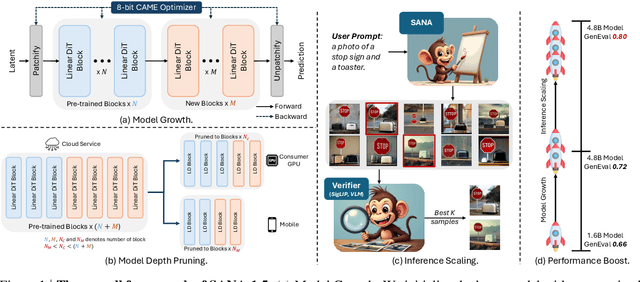


This paper presents SANA-1.5, a linear Diffusion Transformer for efficient scaling in text-to-image generation. Building upon SANA-1.0, we introduce three key innovations: (1) Efficient Training Scaling: A depth-growth paradigm that enables scaling from 1.6B to 4.8B parameters with significantly reduced computational resources, combined with a memory-efficient 8-bit optimizer. (2) Model Depth Pruning: A block importance analysis technique for efficient model compression to arbitrary sizes with minimal quality loss. (3) Inference-time Scaling: A repeated sampling strategy that trades computation for model capacity, enabling smaller models to match larger model quality at inference time. Through these strategies, SANA-1.5 achieves a text-image alignment score of 0.72 on GenEval, which can be further improved to 0.80 through inference scaling, establishing a new SoTA on GenEval benchmark. These innovations enable efficient model scaling across different compute budgets while maintaining high quality, making high-quality image generation more accessible.
MR-COGraphs: Communication-efficient Multi-Robot Open-vocabulary Mapping System via 3D Scene Graphs
Dec 24, 2024Collaborative perception in unknown environments is crucial for multi-robot systems. With the emergence of foundation models, robots can now not only perceive geometric information but also achieve open-vocabulary scene understanding. However, existing map representations that support open-vocabulary queries often involve large data volumes, which becomes a bottleneck for multi-robot transmission in communication-limited environments. To address this challenge, we develop a method to construct a graph-structured 3D representation called COGraph, where nodes represent objects with semantic features and edges capture their spatial relationships. Before transmission, a data-driven feature encoder is applied to compress the feature dimensions of the COGraph. Upon receiving COGraphs from other robots, the semantic features of each node are recovered using a decoder. We also propose a feature-based approach for place recognition and translation estimation, enabling the merging of local COGraphs into a unified global map. We validate our framework using simulation environments built on Isaac Sim and real-world datasets. The results demonstrate that, compared to transmitting semantic point clouds and 512-dimensional COGraphs, our framework can reduce the data volume by two orders of magnitude, without compromising mapping and query performance. For more details, please visit our website at https://github.com/efc-robot/MR-COGraphs.
Mixup Augmentation with Multiple Interpolations
Jun 03, 2024

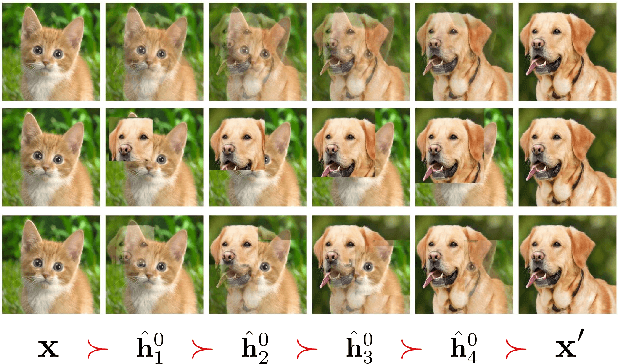
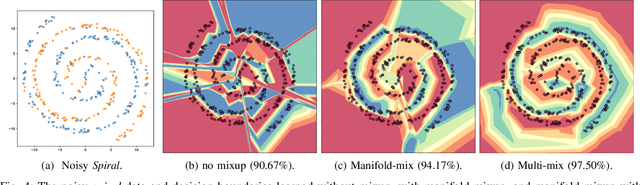
Mixup and its variants form a popular class of data augmentation techniques.Using a random sample pair, it generates a new sample by linear interpolation of the inputs and labels. However, generating only one single interpolation may limit its augmentation ability. In this paper, we propose a simple yet effective extension called multi-mix, which generates multiple interpolations from a sample pair. With an ordered sequence of generated samples, multi-mix can better guide the training process than standard mixup. Moreover, theoretically, this can also reduce the stochastic gradient variance. Extensive experiments on a number of synthetic and large-scale data sets demonstrate that multi-mix outperforms various mixup variants and non-mixup-based baselines in terms of generalization, robustness, and calibration.
Localization matters too: How localization error affects UAV flight
Mar 07, 2024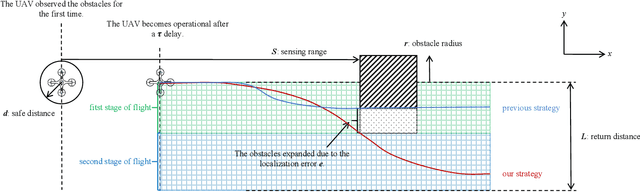
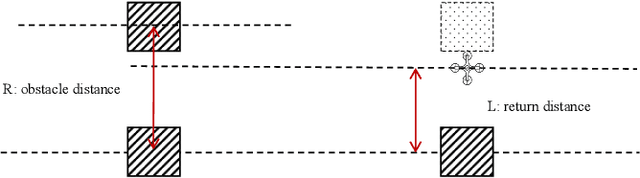
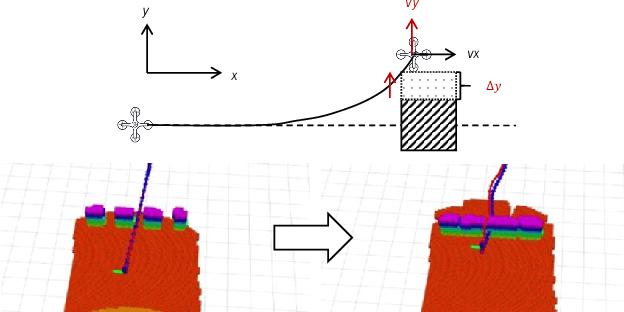
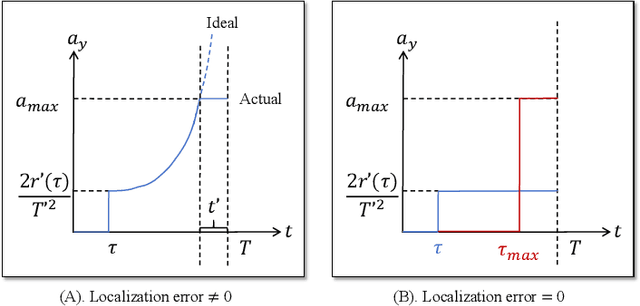
The maximum safe flight speed of a Unmanned Aerial Vehicle (UAV) is an important indicator for measuring its efficiency in completing various tasks. This indicator is influenced by numerous parameters such as UAV localization error, perception range, and system latency. However, in terms of localization errors, although there have been many studies dedicated to improving the localization capability of UAVs, there is a lack of quantitative research on their impact on speed. In this work, we model the relationship between various parameters of the UAV and its maximum flight speed. We consider a scenario similar to navigating through dense forests, where the UAV needs to quickly avoid obstacles directly ahead and swiftly reorient after avoidance. Based on this scenario, we studied how parameters such as localization error affect the maximum safe speed during UAV flight, as well as the coupling relationships between these parameters. Furthermore, we validated our model in a simulation environment, and the results showed that the predicted maximum safe speed had an error of less than 20% compared to the test speed. In high-density situations, localization error has a significant impact on the UAV's maximum safe flight speed. This model can help designers utilize more suitable software and hardware to construct a UAV system.